
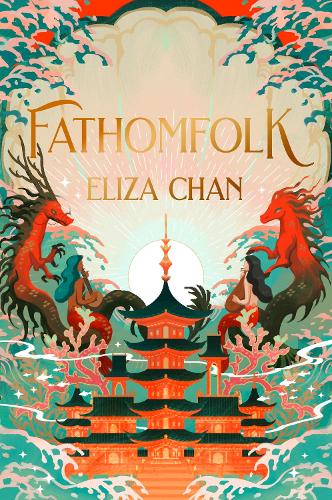
Synopsis
Revolution is brewing in the semi-submerged city of Tiankawi, between humans and the fathomfolk who live in its waters. This gloriously imaginative debut fantasy, inspired by East Asian mythology and ocean folk tales, is a novel of magic, rebellion and change.
Welcome to Tiankawi – shining pearl of human civilization and a safe haven for those fleeing civil unrest. Or at least, that’s how it first appears. But in the semi-flooded city, humans are, quite literally, on top: peering down from shining towers and aerial walkways on the fathomfolk – sirens, seawitches, kelpies and kappas – who live in the polluted waters below.
For half-siren Mira, promotion to captain of the border guard means an opportunity to help her downtrodden people. But if earning the trust and respect of her human colleagues wasn’t hard enough, everything Mira has worked towards is put in jeopardy when Nami, a know-it-all water dragon and fathomfolk princess – is exiled to the city, under Mira’s watch. When extremists sabotage a city festival, violence erupts, as does the clampdown on fathomfolk rights. Both Nami and Mira must decide if the cost of change is worth paying, or if Tiankawi should be left to drown.
Review
As a reader, I was initially drawn to the enchanting premise of “Fathomfolk” and the promise of a richly imagined underwater world. Chan’s prose is evocative, painting a vivid picture of life beneath the sea. However, I found myself struggling to connect with the characters on a deeper level, as their motivations and personalities felt somewhat underdeveloped.
One of the novel’s strengths lies in its imaginative world-building, with Chan crafting a detailed and immersive underwater realm. The inclusion of various mythical creatures adds depth to the setting, creating a sense of wonder and enchantment. Additionally, the novel’s exploration of themes such as cultural identity and political commentary offers thought-provoking moments.
However, the execution of the book fell short of its premise and the promise the world-building showed. I normally like stories told from the perspectives of different characters, such as in Leigh Bardugo’s “Six of Crows”, because it adds a sense of dynamism and lets you see the same world from different, normally interesting perspectives, but this didn’t seem to happen in “Fathomfolk”. I didn’t connect with the characters, which left me feeling disengaged from the story overall and uninvested in the outcome. I was also a little frustrated by the lack of development of some of the characters.
In comparison to other fantasy novels with similar themes, such as “Song of Silver, Flame Like Night” or Leigh Bardugo’s Grishaverse novels, “Fathomfolk” may not reach the same level of depth and complexity. While it offers glimpses of a fascinating underwater world, the novel struggles to fully capitalise on its potential, leaving readers wanting more. I struggled to finish this novel, and though I persevered, I didn’t feel that the ending provided any sort of reward for continuing with the novel.
“Fathomfolk” may appeal to readers who are drawn to lush, imaginative settings and enjoy stories featuring mythical creatures. Eliza Chan’s “Fathomfolk” immerses readers in a visually stunning underwater world filled with mythical creatures and intrigue. While the novel boasts an enchanting premise and lush descriptions, its shortcomings in terms of pacing and character development result in a 3-star rating. It offers moments of wonder and imagination but falls short of fully realising its potential as a captivating fantasy tale.
Rating: ★★★☆☆
 The Ink Thief
One thought on “Book Review: Fathomfolk by Eliza Chan”