
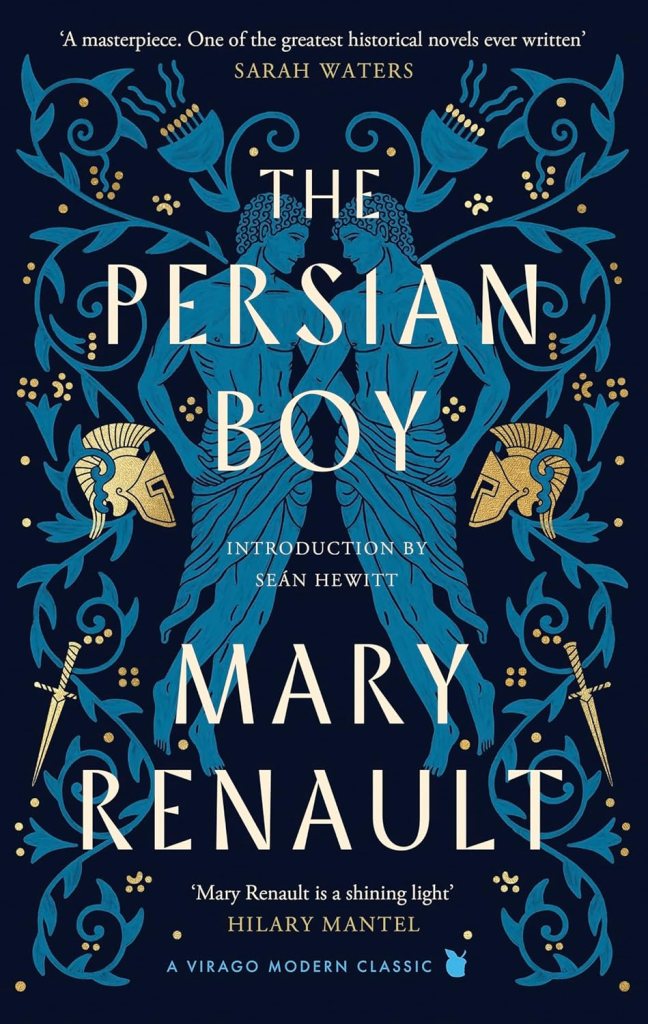
Synopsis
A groundbreaking queer classic and powerful reimagining of the last years of Alexander the Great, told through the eyes of his lover.
I thought, There goes my lord, whom I was born to follow. I have found a king.
And, I said to myself, looking after him as he walked away, I will have him, if I die for it.
Bagoas, abducted as a boy and sold as a eunuch, has been transported to the heart of the Persian court as courtesan to King Darius. But when the Macedon army conquers his homeland, Bagoas finds freedom at the hands of their golden young commander, whose name is already becoming a legend: Alexander.
Their encounter sparks a passionate devotion that shapes the Persian boy’s future – and deepens into a relationship that will sustain them both through assassination plots, political intrigue and the threat of Alexander’s own restless ambition. This is a spellbinding tale of power, loyalty and loss – a vision of history transfigured by love.
Review
Mary Renault’s The Persian Boy is a historical masterpiece that transports readers to the heart of Alexander the Great’s empire, told through the eyes of Bagoas, a Persian eunuch who becomes both lover and confidant to the legendary conqueror. This novel is a gripping exploration of power, love, and loyalty set against the backdrop of one of history’s most fascinating figures.
What makes The Persian Boy truly stand out is Renault’s unparalleled ability to breathe life into the ancient world. Through her vivid, elegant prose, readers are swept into the majesty and turmoil of Alexander’s campaigns, from the luxurious palaces of Persia to the brutalities of battle. Renault’s attention to historical detail is meticulous, but it never overwhelms the story; instead, it deepens the experience, making every moment feel both authentic and emotionally charged.
At the heart of the novel is Bagoas, a Persian nobleman who, after being enslaved, becomes Alexander’s closest companion. His perspective brings a fresh and intimate lens to Alexander’s legend, offering a story not only of military conquests but of the deeply personal connections forged in the midst of empire-building. Bagoas’ love for Alexander is complex and multifaceted, laced with both adoration and vulnerability, and Renault’s portrayal of their relationship is tender yet never sentimental. Through Bagoas, we see Alexander not just as a conqueror, but as a man—flawed, brilliant, and driven by his own need for greatness.
Renault’s characterization of Alexander is one of the novel’s greatest triumphs. He is larger than life, yet fully human, and his dynamic with Bagoas reveals new layers of his personality: his charisma, his ambition, his insecurities, and his capacity for affection. The emotional depth of their relationship gives the novel its heart, and Renault writes with a sensitivity that captures both the passion and the pain of their bond. The novel doesn’t shy away from exploring the darker aspects of both characters’ lives, particularly the trauma that Bagoas endures, but it handles these themes with grace and care.
The Persian Boy also excels as a broader commentary on power and identity. Bagoas’ journey from a defeated Persian youth to a figure of influence in Alexander’s court mirrors the political shifts of the time, as the Persian Empire crumbles and the Greek world expands. Renault’s exploration of Bagoas’ identity as both an outsider and an insider, his struggle with his past, and his navigation of the political intrigues of Alexander’s court are fascinating and deeply human.
Renault’s writing is elegant and poetic, drawing readers into the emotional core of the story while also painting a rich, historically accurate portrait of the ancient world. She masterfully balances the personal and the epic, showing us both the inner workings of Alexander’s empire and the intimate moments that shaped the lives of those closest to him. The pacing is steady, building to a powerful conclusion that is both heartbreaking and inevitable.
In The Persian Boy, Mary Renault not only tells the story of one of history’s most famous figures, but she gives voice to those who were often left in the margins. Bagoas’ story is one of resilience, love, and survival, and Renault tells it with all the richness and complexity it deserves. It’s a novel that resonates long after the final page, offering both a captivating historical narrative and a poignant reflection on human relationships.
For readers of historical fiction, The Persian Boy is an absolute must-read. Renault’s ability to blend historical accuracy with deeply emotional storytelling is unmatched, making this novel a timeless exploration of love, loyalty, and ambition.
 The Ink Thief