
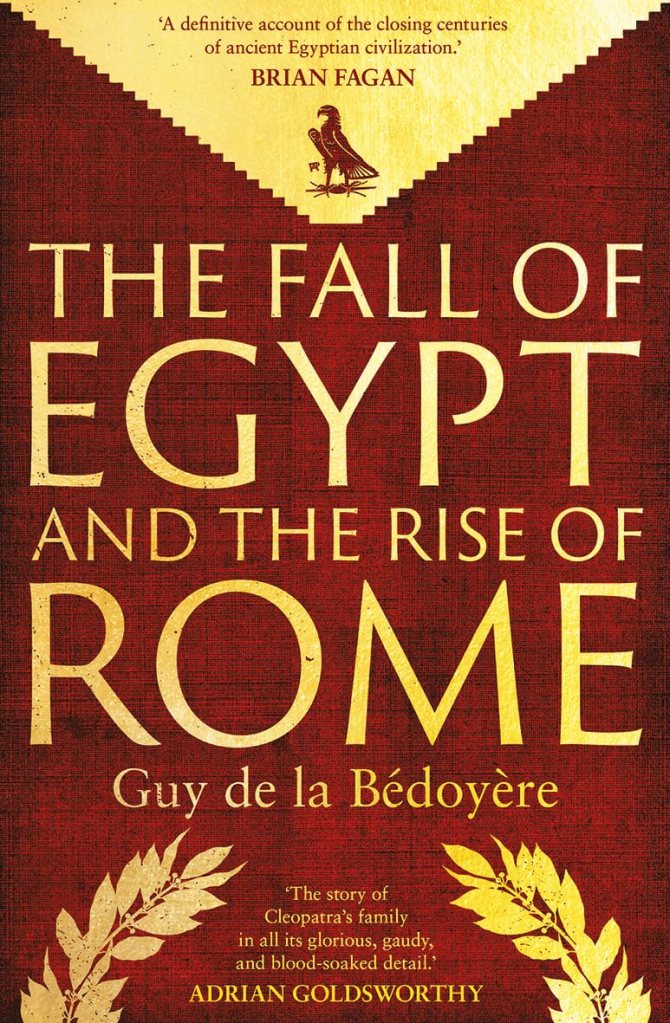
Synopsis
The Ptolemaic era, Egypt’s last and one of its longest dynasties, was in many ways a gilded age. Its early rulers restored and even expanded Egyptian power. Over a span of 300 years the period was witness to intellectual enlightenment, imaginative state-building, and some of the most memorable characters in ancient history, including Alexander the Great and Cleopatra VII.
But these Macedonian Greek pharaohs embarked on ruinous warfare, faced rebellion, and descended into murderous family feuds. Increasingly reliant on the dizzying rise of Roman power, Ptolemaic Egypt was finally annexed by Augustus in 30 BCE. How did such an ancient civilization come to this?
Exploring the lives of the Ptolemaic pharaohs, de la Bédoyère reveals the jealousy, greed, and murderous ambition in their Egypt and the legendary city of Alexandria, their capital. This is a lively, accessible account of Ancient Egypt’s last days—and of the new power rising in its place.
Review
In The Fall of Egypt and the Rise of Rome, Guy de la Bédoyère takes readers on a sweeping journey from the glittering courts of the Ptolemies to the marble-lined forums of the early Roman Empire. This monograph aims to explain how Egypt—once Alexander the Great’s most prized conquest—became subsumed into the burgeoning power of Rome, and how that transformation shaped the Mediterranean world forever.
From the very first pages, de la Bédoyère demonstrates his credentials as a professional historian. He weaves together the fragmentary evidence of papyri, inscriptions, coins and classical literature with the precision of a detective assembling clues. Every claim is footnoted; every chronological jump is meticulously justified. If you have ever wondered what it was like to piece together a lost archive of correspondence from Oxyrhynchus, or to follow the trail of a Roman legion marching across the Libyan desert, this book delivers in vivid, scholarly detail.
Highlights:
- Primary-source immersion: Detailed translations of key papyrus letters (often appearing for the first time in English), which bring to life the ordinary people caught up in epochal change.
- Numismatic insights: Coin-type diagrams that illustrate how currency innovations both reflected and accelerated Rome’s growing economic dominance.
- Political theatre: A blow-by-blow account of the final Ptolemaic court intrigues—complete with rival siblings, regents and foreign agents—that culminated in Cleopatra’s fateful alliance with Mark Antony.
While the depth of research is nothing short of impressive, the sheer volume of detail may overwhelm readers without a solid grounding in Hellenistic or Roman history. Some chapters read more like a doctoral dissertation than a popular history—dense paragraphs on administrative reforms, legal statutes, or tax assessments can slow the narrative momentum. If you pick this up expecting a breezy retelling of Cleopatra’s life and death, you may find yourself reaching for a highlighter instead.
That said, for committed students of the ancient world—or anyone who enjoys drilling down into the “how” as much as the “who”—the granular approach is a strength rather than a liability. De la Bédoyère never glosses over complexities: when he discusses the reorganisation of Egyptian grain shipments to feed Roman legions, you feel the full weight of logistical genius (and nightmare) behind empire building.
De la Bédoyère’s prose is clear, authoritative and—when he lets it—sprightly. His occasional wry turn of phrase (for example, describing a notoriously evasive Ptolemaic courtier as “the Houdini of Alexandria”) enlivens what could otherwise be very dry fare. Headings and subheadings are used judiciously to guide the reader through labyrinthine arguments, and each chapter ends with a concise summary of “Key Developments,” which is extremely helpful for review.
If there is a stylistic quibble, it’s that the narrative sometimes jerks between micro-history vignettes (the day-to-day life of a temple scribe) and sweeping geopolitical analysis without much transitional framing. A stronger connective thread might have smoothed these shifts.
The Fall of Egypt and the Rise of Rome is not a casual afternoon’s read—but for those willing to invest the time, it offers one of the most authoritative single-volume treatments of this pivotal era. Guy de la Bédoyère’s command of sources, combined with his aptitude for clear exposition, makes this book an indispensable addition to any student’s or scholar’s shelf. If your passion is the ancient Mediterranean—and you crave depth over brevity—this will quickly become your new go-to reference.
Rating: 💧💧💧💧.5/5
(Deducted half a drop only because not every reader will have the patience for its encyclopaedic scope.)
 The Ink Thief