
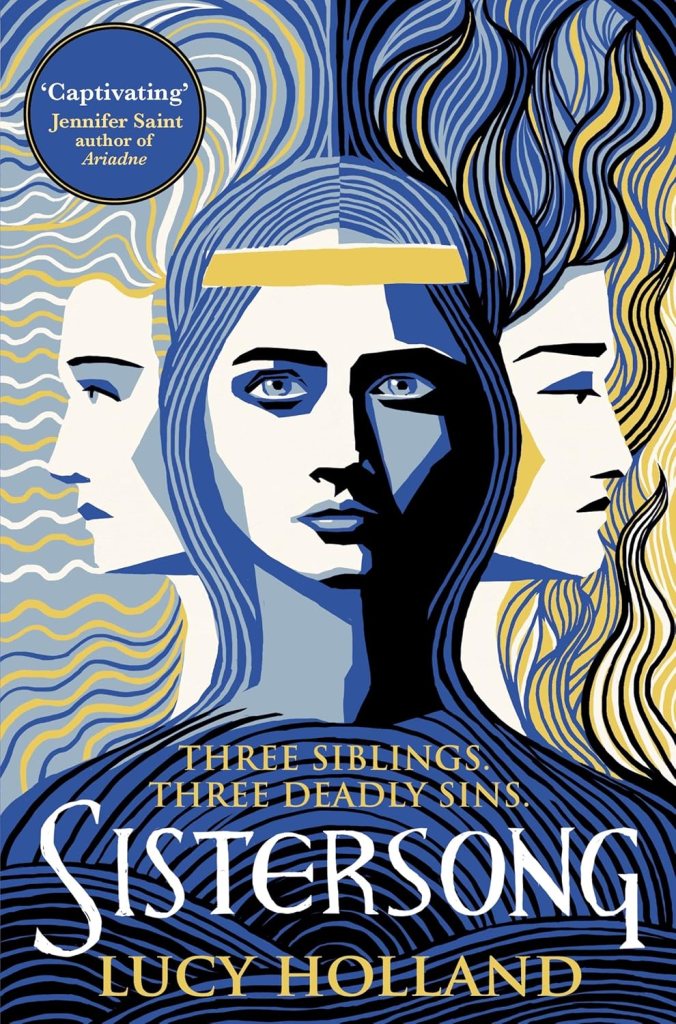
Synopsis
King Cador’s children inherit a land abandoned by the Romans, torn by warring tribes. Riva can cure others, but can’t heal her own scars. Keyne battles to be seen as the king’s son, although born a daughter. And Sinne dreams of love, longing for adventure.
All three fear a life of confinement within the walls of the hold, their people’s last bastion of strength against the invading Saxons. However, change comes on the day ash falls from the sky – bringing Myrdhin, meddler and magician. The siblings discover the power that lies within them and the land. But fate also brings Tristan, a warrior whose secrets will tear them apart.
Riva, Keyne and Sinne become entangled in a web of treachery and heartbreak and must fight to forge their own paths. It’s a story that will shape the destiny of Britain.
Review
Sistersong is a novel that gripped me almost immediately – and then, frustratingly, lost its footing just as it reached its conclusion. It’s a book full of promise, rich themes, and strong character work, but one that ultimately falters under the weight of its own ambition.
From the outset, Sistersong is deeply atmospheric. Set against the backdrop of early medieval Britain, Holland weaves a world poised on the edge of religious upheaval: the old gods and the worship of Brigid slowly being pushed aside by the encroaching influence of Christ. The tension between these belief systems hums constantly in the background – at times a little too heavy-handed, but always present and somewhat believable. The conversion, the pressure, the resentment of those who still follow the old ways – it could have been handled with more nuance, though perhaps this is an unreasonable expectation of a reader who is also a historian.
For much of the book, the characterisation is one of Sistersong’s strongest elements. Each of the three sisters – Sinne, Riva, and Keyne – feels distinct, fully realised, and shaped by their own fears, flaws, and desires. Unfortunately, this solidity begins to unravel towards the end, where character arcs feel rushed or warped to serve the plot.
Keyne is by far the emotional heart of the novel. Their journey – the slow, painful acceptance of who they are, their gender, and the deep discomfort of being forced into a role that doesn’t fit – is beautifully handled. The exploration of gender here is thoughtful and tender, and watching Keyne come to terms with the fact that they are not a woman feels authentic and deeply human. Of the three sisters, Keyne is the one I empathised with most from beginning to end.
Riva, meanwhile, is more complicated. While I sympathised with her anger and trauma, there were moments when her wrath and pride became frustrating. Her refusal to trust her sisters, her inability to admit she needs help, and her tendency to see only her own pain often cloud her judgment. These flaws are understandable – but they also make her difficult to like at times.
Sinne is, without question, my least favourite sister – and that’s largely intentional. Her chapters are the hardest to read, not because they’re poorly written, but because she is so profoundly self-centred. She’s vain, proud, and narrowly focused on her own feelings, with little empathy for those around her. She cannot grasp why Keyne feels violated when forced into a dress, nor why Riva is so deeply scarred by what’s happened to her. Her casual manipulation of the fisherman’s son using her gift, and her blindness to Gildas’ growing influence, make her deeply uncomfortable to sit with. Vanity and pride are her defining sins.
Sadly, where Sistersong truly stumbles is in its ending. What should have been a powerful, emotionally resonant conclusion instead feels rushed, chaotic, and messy. Revelations about certain characters are either painfully obvious or jarringly out of place, and some character endings feel oddly unsatisfying after such careful build-up.
There’s also a sense of emotional whiplash that doesn’t quite work. After spending most of the novel disliking Sinne, the narrative suddenly pushes the reader toward sympathy for her, while Riva is framed in an increasingly negative light. This rapid shift isn’t given enough space to breathe, and rather than feeling earned, it feels disorienting. The result is an emotional pivot that’s more confusing than cathartic.
Sistersong is a novel I admired more than I loved. Its exploration of gender, faith, and identity is thoughtful and often beautifully done, and its early chapters are gripping and immersive. But the uneven character resolutions and rushed ending prevent it from fully delivering on its potential.
Still, this is a book with a strong voice, bold themes, and moments of real emotional power, especially through Keyne’s story. If you’re interested in mythic retellings, religious transition, and complex sibling dynamics, Sistersong is well worth reading, even if it doesn’t quite stick the landing.
Rating: ★★★☆☆
Have you read Sistersong? If so, what were your thoughts on it?
 The Ink Thief