
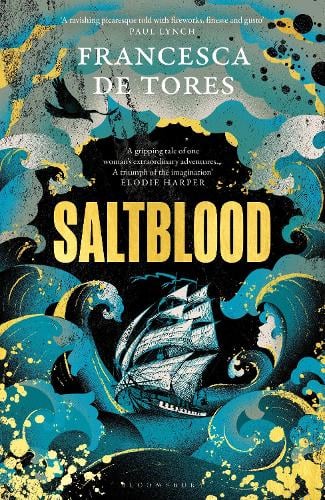
Synopsis
In a rented room outside Plymouth in 1685, a daughter is born as her half-brother is dying. Her mother makes a decision: Mary will become Mark, and Ma will continue to collect his inheritance money.
Mary’s dual existence as Mark will lead to a role as a footman in a grand house, serving a French mistress; to the navy, learning who to trust and how to navigate by the stars; and to the army and the battlegrounds of Flanders, finding love among the bloodshed and the mud. But none of this will stop Mary yearning for the sea.
Drawn back to the water, Mary must reinvent herself yet again, for a woman aboard a ship is a dangerous thing. This time Mary will become something more dangerous than a woman. She will become a pirate.
Breathing life into the Golden Age of Piracy, Saltblood is a wild adventure, a treasure trove, weaving an intoxicating tale of gender and survival, passion and loss, journeys and transformation, through the story of Mary Read, one of history’s most remarkable figures.
Review
Saltblood surprised me – in the best possible way. I don’t usually get on particularly well with first-person narratives, but from the very first chapters, I found myself completely immersed in Mary Read’s voice. It’s intimate without being claustrophobic, vivid without tipping into melodrama, and it draws you into the story with an almost confessional pull.
Mary Read is a historical figure we know frustratingly little about, and Saltblood leans into that uncertainty rather than fighting it. Francesca de Tores takes the sparse historical record and carefully, thoughtfully fills in the gaps, crafting a version of Mary’s life that feels not only compelling but believable. This never feels like historical fan-fiction; instead, it reads as a deeply considered imagining of what Mary’s life could have been like – shaped by hardship, disguise, violence, loyalty, and the unforgiving pull of the sea.
There’s a quiet confidence in how de Tores handles history here. She never overstates the facts, but she uses them as anchors, allowing the emotional truth of the story to carry the weight.
Despite my usual reservations about first-person narration, Mary’s voice won me over completely. It’s raw, pragmatic, and shaped by survival. Through her eyes, we experience not just the physical danger of her life, but the emotional cost of existing on the margins – of constantly negotiating identity, safety, and belonging. The immersion is so effective that the world of the novel begins to feel salt-stained and close, as though you’re living alongside her rather than merely observing.
One of Saltblood’s greatest strengths is its character work. Even figures who only pass briefly through Mary’s life feel real and emotionally grounded. These are characters you root for, grieve for, and sometimes come to loathe – and that emotional investment gives the novel much of its power. De Tores clearly understands that a protagonist is only ever as strong as the people who shape, challenge, and oppose them, and the antagonists here are every bit as vivid as the allies.
This emotional attachment makes the novel’s losses and betrayals hit harder, lending weight to moments that could otherwise feel episodic.
There were moments where Saltblood pushed a little too far, even for me. Certain sections feel deliberately brutal, as though the novel is testing the reader’s endurance. While this harshness is often justified by the realities of Mary’s life, there are points where it borders on excess. That said, these moments never entirely pulled me out of the story – they simply made me pause.
The ending, thankfully, delivers. It feels earned, coherent, and emotionally satisfying – a rarity for novels that tread the line between history and imagination. I closed the book feeling complete rather than let down, which is no small thing.
Saltblood is immersive, emotionally resonant historical fiction that gives voice to a woman history largely forgot. Francesca de Tores writes with confidence, empathy, and a keen understanding of character, transforming fragments of fact into a story that feels whole. Despite a few moments that verge on being too much, this is a novel that lingers – salty, sharp, and human.
 The Ink Thief