Synopsis
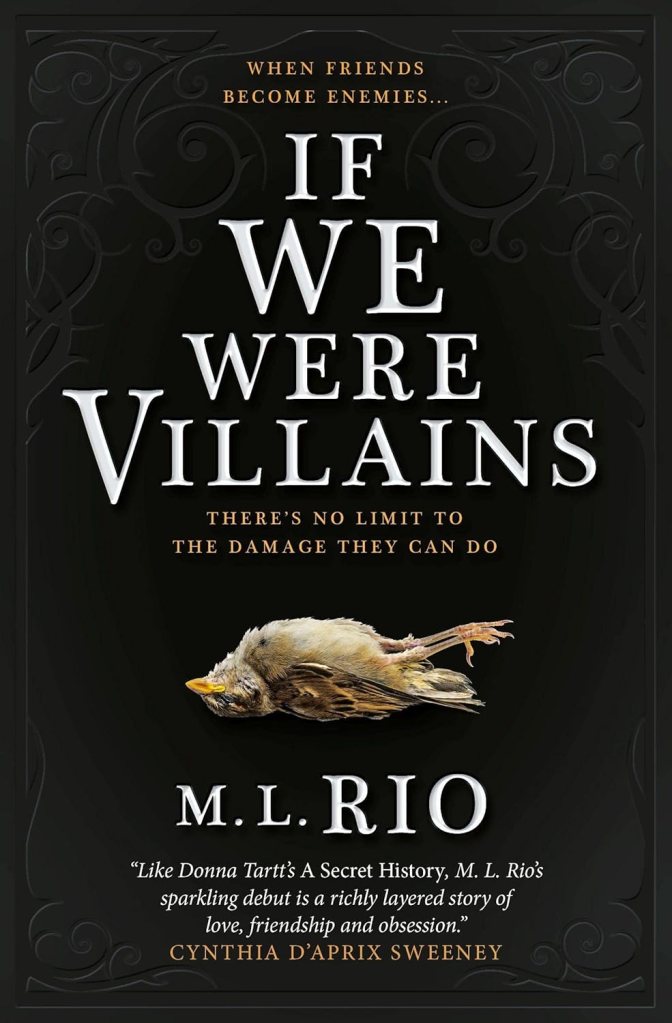
Oliver Marks has just served ten years in jail – for a murder he may or may not have committed. On the day he’s released, he’s greeted by the man who put him in prison. Detective Colborne is retiring, but before he does, he wants to know what really happened a decade ago.
As one of seven young actors studying Shakespeare at an elite arts college, Oliver and his friends play the same roles onstage and off: hero, villain, tyrant, temptress, ingénue, extra. But when the casting changes, and the secondary characters usurp the stars, the plays spill dangerously over into life, and one of them is found dead. The rest face their greatest acting challenge yet: convincing the police, and themselves, that they are blameless.
Review
If We Were Villains is a novel that draws you in from its very first line and refuses to let go. Dark, theatrical, and deeply immersive, it’s a love letter to Shakespeare, performance, and obsession – and a compelling example of why dark academia continues to resonate so strongly with readers.
Set within the cloistered world of an elite arts conservatory, the novel revels in all the hallmarks of dark academia: intense friendships, intellectual fixation, moral ambiguity, and an undercurrent of inevitable tragedy. The Shakespearean framework is not just decorative here – it’s structural. The plays the characters study, perform, and live within mirror their own relationships, rivalries, and downfalls, lending the story a sense of dramatic inevitability that feels both deliberate and deeply satisfying.
The comparisons to The Secret History are understandable – and, in many ways, inevitable. Like Donna Tartt’s seminal novel, If We Were Villains explores insular academic spaces, group dynamics, and the consequences of intellectual and emotional excess. However, this book stands on its own merits, particularly in its theatricality and emotional immediacy.
The characters are engaging and well-crafted, each shaped by their chosen Shakespearean archetype. Their friendships are intense, codependent, and occasionally cruel, but always compelling to watch unfold. There’s a performative quality to their interactions – on stage and off – that blurs the line between role and reality, raising the question of whether they are shaped by the characters they play, or drawn to those roles because they reflect something already within them.
What makes this especially effective is how quickly the novel establishes its premise and stakes. From the opening pages, you’re aware that something has gone terribly wrong, and that sense of foreboding colours everything that follows.
This is a book that clearly divides opinion. For some readers, the heavy reliance on Shakespeare can feel alienating or dull – particularly if they’re unfamiliar with the plays or uninterested in theatrical analysis. For others, that very focus is the book’s greatest strength.
I fall firmly into the latter camp. I loved the Shakespearean connections and found them enriching rather than obstructive. I also think it helped that I picked up this novel without much knowledge of the surrounding hype, and that I read it before The Secret History. Without preconceived expectations or constant comparison, I was able to enjoy If We Were Villains on its own terms—something that I suspect has shaped my more positive experience.
The twist near the end, along with the novel’s conclusion, is genuinely surprising and very well executed. It recontextualises much of what came before without feeling cheap or manipulative, and it brings the story to a close in a way that feels thematically coherent and emotionally resonant.
If We Were Villains is engrossing, stylish, and unapologetically theatrical. It may not be for everyone – but for readers who enjoy dark academia, morally complex characters, and literature steeped in performance and obsession, it’s a richly rewarding read.
 The Ink Thief