
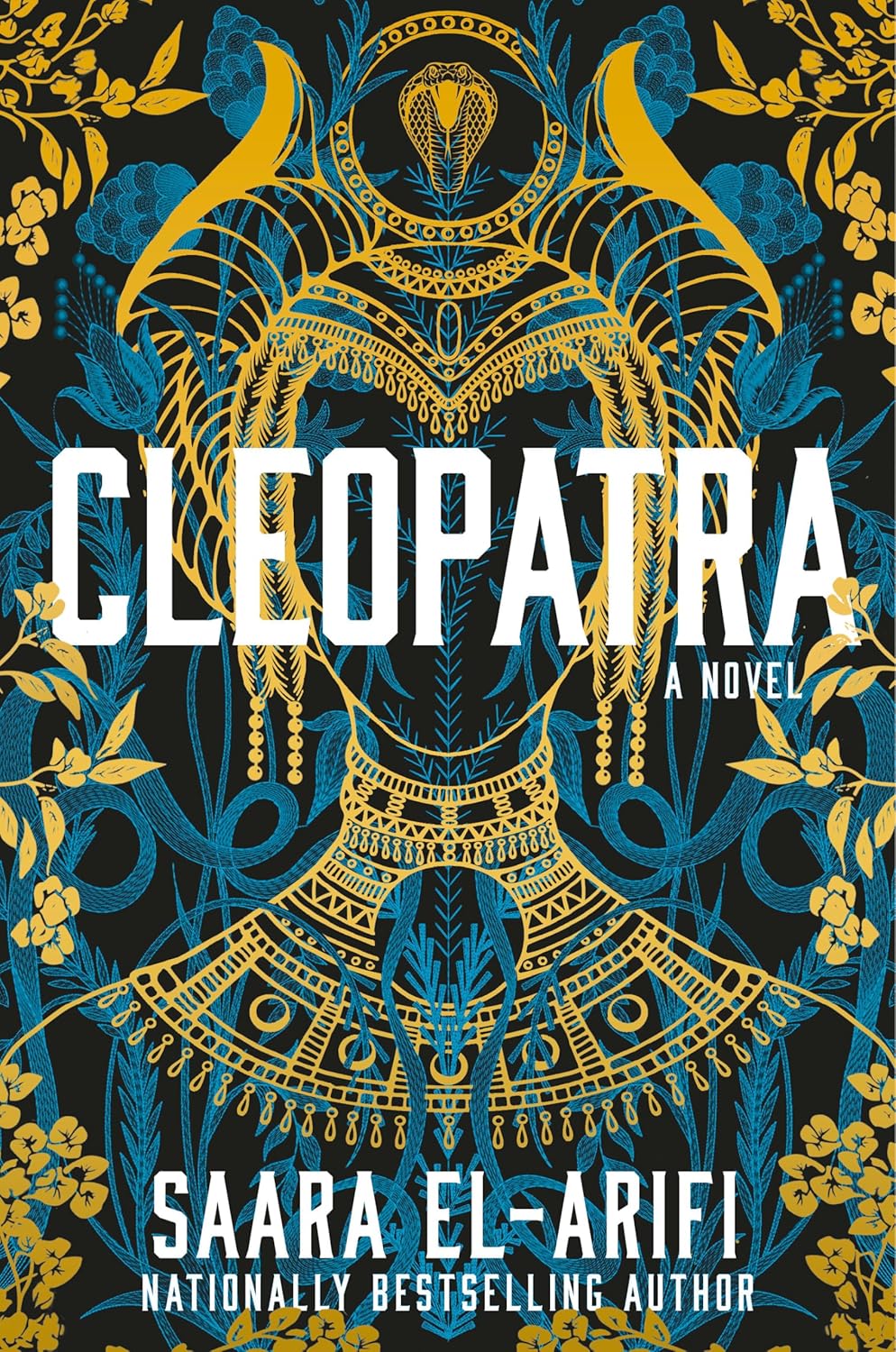
Synopsis
YOU KNOW MY NAME.BUT YOU DO NOT KNOW ME.
Your historians call me seductress, but I was ever in love’s thrall.
Your playwrights speak of witchcraft, but my talents came from the gods themselves.
Your poets sing of my bloodlust, but I was always protecting my children.
How wilfully they refuse to concede that a woman could be powerful, strategic, divinely blessed to rule.
Death will silence me no longer.
This is not the story of how I died. But how I lived.
Review
Saara El-Arifi is an author whose work I’ve admired for her vivid storytelling, compelling characters, and immersive worlds, so I went into Cleopatra with high expectations. While there is certainly plenty to appreciate here, this ultimately proved to be a novel I admired more than I loved. It’s an enjoyable read, but one that never quite captured my imagination in the way I had hoped.
My biggest issue with the novel is, perhaps unsurprisingly, Cleopatra herself.
Historical fiction lives and dies by its ability to breathe life into figures from the past, and while El-Arifi presents an interesting interpretation of one of history’s most famous women, I never truly felt as though I was reading about Cleopatra. Instead, it often felt as though I was reading about an original fictional heroine who happened to share Cleopatra’s name and circumstances.
That isn’t necessarily a criticism of the character herself – she’s engaging enough – but rather of the connection between the historical figure and her fictional counterpart. Cleopatra has endured for over two thousand years as a politician, linguist, strategist, ruler, and one of antiquity’s most misunderstood women. Here, I found myself longing for more of that complexity. I wanted to come away feeling as though I better understood her, rather than simply having followed an entertaining story inspired by her life.
That isn’t to say the novel lacks strengths. El-Arifi’s prose remains accessible and engaging, making for an easy read, and there are flashes of the emotional depth that made me enjoy her previous work so much. Relationships are given room to breathe, and the novel explores themes of identity, power, loyalty, and survival with sensitivity.
However, I couldn’t shake the feeling that the story never quite reached the emotional heights I’d come to expect from her. There were moments that should have felt monumental – politically or personally – but they often passed without leaving a lasting impression. Rather than being swept up in Cleopatra’s rise and struggles, I found myself observing them from a distance.
Retelling the life of Cleopatra is no easy task. She is one of history’s most mythologised figures, burdened by centuries of Roman propaganda, popular culture, and modern reinterpretation. Any novelist has to decide which version of Cleopatra they want to present, and El-Arifi clearly isn’t interested in simply recreating the familiar legend.
I admired that ambition, even if the execution didn’t entirely work for me. At times, the novel seemed more interested in exploring universal themes than in inhabiting the particular personality of Cleopatra herself. As a result, the story occasionally lost the sense of specificity that makes the best historical fiction so memorable.
Cleopatra is by no means a bad novel. It’s well-written, thoughtfully constructed, and offers an accessible reimagining of one of history’s most iconic women. But for me, it lacked the spark that made Saara El-Arifi’s previous books so compelling. I never felt completely immersed, nor did I ever feel like I had truly come to know Cleopatra herself.
Perhaps that’s the greatest disappointment. A novel about one of history’s most fascinating women should leave you feeling as though you’ve spent time in her company. Instead, I finished the book feeling as though I’d met someone inspired by Cleopatra, rather than Cleopatra herself.

