Synopsis
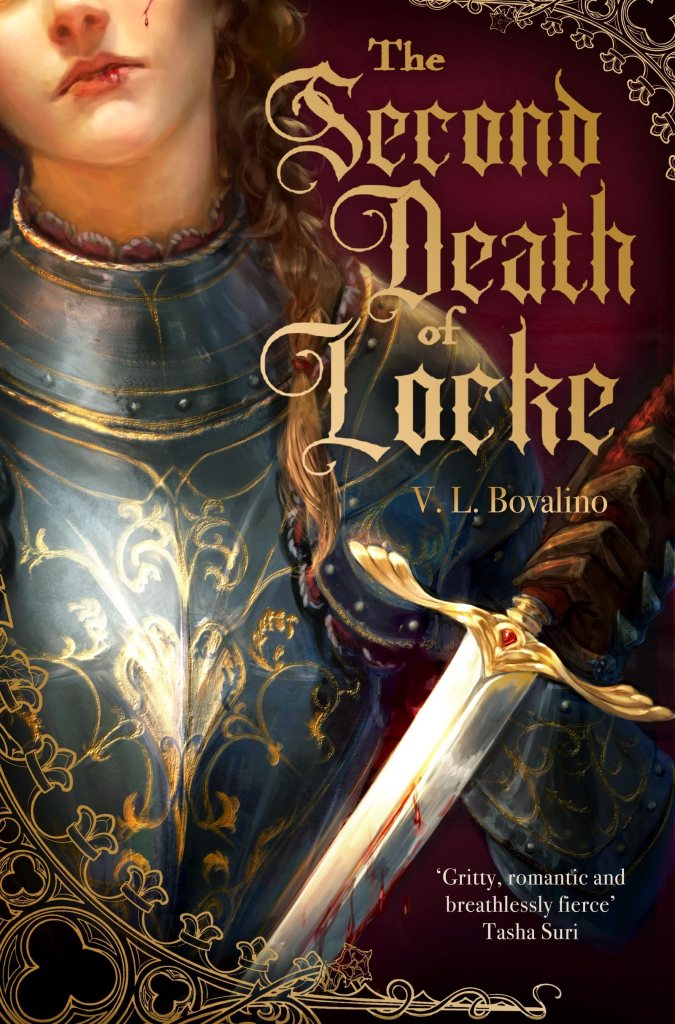
Grey Flynn has dedicated her life to her mage, Kier.
She will be his blade on the battlefield, his healer and protector. The deep well of raw power inside her is Kier’s to use. Grey would do anything for Kier – be anything for him – if he would only ask.
When a quest to protect the child of an enemy kingdom pulls them into the dangerous heart of their nation’s war, Grey and Kier will need to decide what they are willing to sacrifice to protect their secret.
For Grey is no ordinary magical well, but heir to the lost island of Locke – the root of all power. If she dies, all magic dies with her.
The Second Death of Locke is a devastatingly romantic epic fantasy about the undying bond between a knight and their mage, perfect for fans of The Knight and the Moth and The Six Deaths of the Saint.
Review
The Second Death of Locke had all the ingredients of a book I should have absolutely adored. Lady knights? A medieval-inspired setting? A rich magical world built around loyalty, sacrifice, and political conflict? It sounded as though it had been written specifically for me. And while there is a great deal here that I genuinely enjoyed, it ultimately never quite came together in the way I’d hoped.
As is so often the case with romantasy, my favourite aspect of the novel was its world-building. Bovalino creates an intriguing magic system centred around the bond between mages and their “wells” of power, weaving it into a kingdom shaped by war, ancient bloodlines, and competing political interests. The central premise – that Grey is both a knight and the source of her mage’s magic – is compelling from the outset, and the mythology surrounding the lost island of Locke adds another fascinating layer to the world.
It’s the sort of setting that immediately sparks your imagination. Unfortunately, I also found myself wishing the novel had done a little more with it. There are glimpses of fascinating political tensions, religious undertones, and military structures that never quite receive the attention I felt they deserved. The pieces are all there for a truly epic fantasy, but the focus remains firmly on the romance.
Grey was, without question, my favourite character. She’s brave, fiercely loyal, and carries the emotional weight of the novel with quiet determination. I found her far more compelling than Kier, whose gentleness is undoubtedly appealing but who never felt quite as layered to me.
That said, I couldn’t help feeling that the novel underused one of its greatest strengths: Grey is a lady knight, yet there were surprisingly few opportunities to really see her embracing that role. I wanted more training, more battlefield strategy, more moments that showcased her skill and identity as a knight beyond simply being Kier’s protector. Other readers have praised the yearning between Grey and Kier as the novel’s emotional core, but I found myself wanting more emphasis on Grey’s own journey and her place within this world.
This is where I suspect the issue lies more with me than with the book.
Grey and Kier’s relationship is tender, full of longing, and built on years of friendship and unwavering devotion. I can completely understand why so many readers have fallen in love with their romance, and if you’ve been enjoying the current wave of romantasy, I suspect this relationship will absolutely work for you. Judging by the overwhelmingly positive reception, I’m very much in the minority here.
For me, however, it never quite ignited. I appreciated their affection for one another, but I wasn’t emotionally swept away by it. Increasingly, I’ve found myself drifting away from romantasy as a genre, often wishing the stories would spend just a little less time on the romance and a little more time exploring the worlds, politics, and magic systems they create. The Second Death of Locke is no exception. I found myself repeatedly more interested in the mythology of Locke, the history of the kingdom, and Grey’s role as a knight than I was in the central love story.
It’s not that I don’t like romance in my stories – the various romances in Six of Crows and the central romance in Morgan is My Name are all very compelling – but they’re never the main focus of the story, which is why I think I’ve fallen out of love with romantasy as a genre, so perhaps I wasn’t the best person to review a romantasy book. But I do wish that these very compelling premises could fully explore what they promise. I enjoyed everything else about the book, but the romance seemed to drag at times, and distracted at others.
Perhaps that’s why, despite enjoying the novel throughout, I finished it with the lingering feeling that it had fallen just short of greatness. The foundations are incredibly strong: an imaginative magic system, an evocative medieval-inspired world, and a protagonist I genuinely liked. Yet I couldn’t shake the sense that these elements could have been pushed even further.
The Second Death of Locke is a solid romantasy with an engaging premise, a memorable heroine, and a beautifully realised fantasy world. While the romance didn’t resonate with me as strongly as it clearly has for many other readers, I still found plenty to admire in Bovalino’s writing—particularly the world-building and Grey herself.
If you’re a fan of romantasy, especially stories built around yearning, devotion, and magical bonds, I suspect you’ll enjoy this far more than I did. But for readers like me, who increasingly find themselves craving the politics, mythology, and knightly exploits over the romance, it may leave you wishing it had leaned just a little further into its fantasy roots.

