Synopsis
Grieving over a devastating loss, Morgan has retreated to the sanctuary of Belle Garde behind a veil of fairy magic, after swearing vengeance upon King Arthur and Camelot.
Steeped in her rage, she becomes a storm of retribution, battling to avenge her brother’s wrongs while trying to undo a terrible tragedy. But with her resurrection skills elusive and Camelot growing in glory and strength, Morgan is failing, her freedom under threat in the wake of her chaos and treasonous reputation.
All appears futile, until her efforts bring news of scandal in the Royal Court, and Morgan is once again drawn inside Camelot’s golden walls. When an encounter with Arthur’s trusted knight, Sir Lancelot, sparks suspicions of Queen Guinevere’s adultery, Morgan falls deeper into obsession, the need to punish those who betrayed her driving her further away from her loved ones, and the woman she once wished to be.
As the Age of Camelot darkens, and the forces of love, fate and truth collide, she must choose between her thirst for vengeance and the power to heal what is broken, and decide who Morgan le Fay truly is, in her own future and for all time.
Review
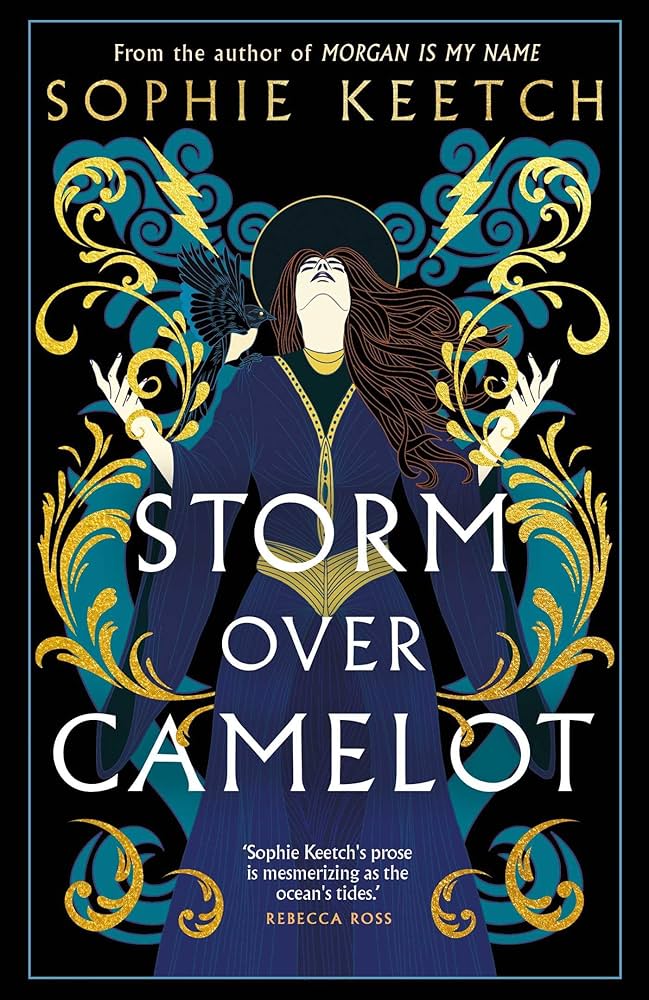
There are very few series that manage to become better with every instalment, and even fewer that leave me staring at the final page thinking, “well, I suppose I have to find a new favourite now”. Storm Over Camelot is a truly incredible conclusion to Sophie Keetch’s Arthurian trilogy, and I think it has officially put the series in contention with Leigh Bardugo’s Six of Crows duology for the title of my favourite fantasy series.
At the heart of the trilogy, as she has been from the beginning, is Morgan – and I adore her. What I love most about Keetch’s Morgan is that she feels both completely her own character and entirely believable within the Arthurian tradition. Her actions can be terrible. She lies, she betrays, she manipulates, she makes decisions fuelled by anger and grief, and sometimes she does genuinely awful things. But she is never reduced to the role of villain. Instead, Keetch asks us to look at the stories we already know and consider what they might look like from Morgan’s side.
And that is, ultimately, what makes this feel less like a traditional retelling and more like a re-examination of Arthurian myth. The familiar stories are still there, but Keetch turns them over and looks at them from another angle. Betrayals have explanations. Lies have motives. Actions that have been passed down through centuries as evidence of Morgan’s wickedness are given context. Sometimes her reasons are entirely understandable; sometimes they’re misguided; and sometimes she’s simply angry, hurt, frightened, or human.
Crucially, Keetch never excuses Morgan’s actions simply because we understand them. Morgan can be sympathetic and still do terrible things. She can have good intentions and cause enormous harm. That complexity is what makes her such a compelling protagonist.
This book also introduces Lancelot into the story, and I thought Keetch’s interpretation of him was superb. He is recognisably the Lancelot of Arthurian legend: the brilliant knight, the paragon of chivalry, the man whose love for Guinevere ultimately creates one of the great tragedies of the Arthurian tradition. But, as with Morgan, Keetch allows us to see the person beneath the legend.
We see Lancelot as the son of Ninniane of the Lake, shaped by his upbringing and his own complicated relationship with the world around him. We see his loyalty, his flaws, his love for Guinevere – and, perhaps most importantly, his genuine love for Arthur. That makes the familiar story of the love triangle considerably more complicated. Nobody is simply a villain or a hero. These are people who love one another, hurt one another, make terrible decisions, and have to live with the consequences.
The return of Accolon is everything I wanted it to be and absolutely nothing I was emotionally prepared for. It is heartbreaking, wonderful, bittersweet, and almost painfully satisfying. It’s the sort of storyline where you’ve spent half the series desperately wanting something to happen while simultaneously dreading the possibility that it actually might. Keetch handles it beautifully, allowing the emotional weight of their history to sit with us rather than rushing through it. It was one of those moments where I found myself simultaneously thinking “finally!” and “oh no, please don’t do this to me.”
Morgan isn’t the only character who shines. Yvain, Morgan’s son, is another fantastic addition to the story, and I particularly enjoyed seeing how his relationship with his mother develops. There is a real sense that these characters have histories beyond the pages we’re reading, and that makes their relationships feel wonderfully lived-in. And then there is Mordred. Keetch’s Mordred is terrible. Truly, spectacularly, repulsively terrible.
What I particularly appreciate is that, as with Morgan, we are given reasons for his actions. We understand where some of his hatred and resentment come from. But understanding is not the same as forgiveness, and Keetch doesn’t make the mistake of suggesting that it is. There is a fascinating distinction between explaining a character and excusing them, and this trilogy handles that distinction exceptionally well.
The plotting is another of the trilogy’s greatest strengths. Storm Over Camelot is exciting without feeling rushed. There are battles, betrayals, revelations, political manoeuvring, romance, heartbreak and all the other things you’d expect from an Arthurian epic, but Keetch doesn’t feel the need to race from one dramatic moment to the next.
Instead, she lets us sit with things. She gives each character and each significant moment enough space for us to process what has happened, form our own judgements, and perhaps even develop our own theories about where things might go next. And then, just when you’ve had enough time to catch your breath, the story moves on to something equally thrilling, devastating, or unexpected. It makes the whole thing feel remarkably immersive. I never felt as though I was being dragged through the plot simply to get to the next big revelation.
And then there’s the ending. I don’t think I could have asked for a better conclusion to this trilogy. It is bittersweet – as an Arthurian story almost inevitably has to be – but it isn’t hopeless. There is loss, there is tragedy, and there are consequences for the choices these characters have made. But there is also hope. There is the sense that, even after everything, something can endure. It feels earned. More importantly, it feels right. After spending three books looking at Arthurian legend through Morgan’s eyes, I couldn’t imagine an ending that would have suited the story better.
Sophie Keetch has done something genuinely special with this trilogy. Rather than simply retelling the familiar Arthurian stories, she has taken the myths we think we know and asked us to reconsider them. What if Morgan wasn’t the villain? What if the betrayals had reasons? What if the people behind the legends were simply people – flawed, complicated, loving, angry, frightened, and capable of both kindness and cruelty?
Storm Over Camelot brings all of that together in a conclusion that is thrilling, heartbreaking, beautifully character-driven, and ultimately hopeful. I adored these characters. I adored this world. And I am genuinely sad to leave it behind.

